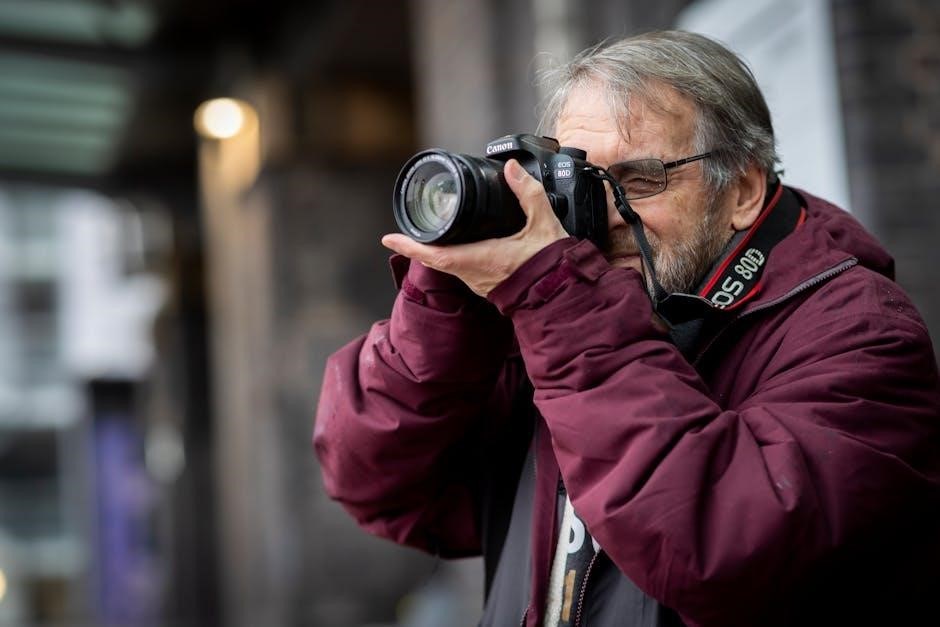
canon 80d owners manual
Canon 80D Owners Manual: A Comprehensive Guide
This manual expertly guides users through the Canon 80D’s features, from initial setup and controls to advanced techniques, ensuring optimal photographic results.
Welcome to the world of the Canon 80D, a powerful and versatile DSLR designed for both enthusiasts and professionals. This camera builds upon Canon’s legacy, incorporating advanced technology like the DIGIC 6 image processor. It offers a compelling blend of performance, features, and usability.
This guide will unlock the 80D’s full potential, covering everything from basic operation to complex customization. Explore its 24.2MP sensor, intelligent autofocus system, and impressive video capabilities. Prepare to elevate your photography with this comprehensive resource!
Unboxing and Initial Setup
Carefully unpack your Canon 80D, ensuring all components are present: camera body, battery, charger, strap, and manuals. Insert the battery and charge it fully before first use. Install the strap for secure handling. Insert a compatible SD card into the designated slot.
Power on the camera and follow the on-screen prompts to set the language, date, and time. Register your camera online for warranty benefits and access to updates. Familiarize yourself with the initial menu settings for a smooth start.
Understanding the Camera Body & Controls
The Canon 80D boasts a robust build and intuitive control layout. Locate the power switch, shutter button, mode dial, and main dials for adjusting settings. Explore the rear panel, identifying the LCD screen, directional buttons, and menu access.
Understand the function of the autofocus point selection joystick and the quick control dial. Familiarize yourself with the placement of ports for external accessories like microphones and headphones. A thorough understanding of these elements is crucial for efficient operation.
Button and Dial Functions
The Canon 80D’s buttons and dials offer direct control over key settings. The main dial adjusts aperture in Av mode or shutter speed in Tv mode. The quick control dial modifies exposure compensation and settings within menus.
The AF point selection joystick precisely selects focus points. The dedicated autofocus start button (if equipped) initiates autofocus independently. Learn to customize button functions via the custom function menu for personalized control, streamlining your workflow and enhancing shooting speed.
Viewfinder and LCD Screen Overview
The Canon 80D features a bright optical viewfinder providing a clear, real-time view of your scene with approximately 100% coverage. The LCD screen is a 3;0-inch vari-angle touchscreen, enabling flexible shooting from various angles.
Information displayed in the viewfinder includes focus points, exposure settings, and shooting mode. The LCD facilitates live view shooting, menu navigation, and image playback. Utilize the LCD’s touchscreen for quick setting adjustments and intuitive operation.
Shooting Modes Explained
The Canon 80D offers a versatile range of shooting modes to suit diverse photographic scenarios. Automatic modes simplify operation for beginners, while semi-automatic modes (Av, Tv, P) grant creative control over aperture, shutter speed, or both.
Full Manual mode (M) provides complete command over all settings, ideal for experienced photographers. Scene Intelligent Auto analyzes the scene and optimizes settings. Explore creative filters and custom modes for personalized shooting experiences.
Automatic Shooting Modes

Canon 80D’s automatic modes deliver ease of use for effortless photography. Scene Intelligent Auto intelligently detects the scene – portrait, landscape, sports, etc. – and optimizes camera settings accordingly. Flash Off mode disables the flash, preserving natural lighting.
The Sports mode prioritizes fast shutter speeds to freeze action, while Night mode enhances low-light performance. These modes are perfect for beginners or situations demanding quick, reliable results without manual adjustments.
Semi-Automatic Modes (Av, Tv, P)
Canon 80D’s semi-automatic modes offer creative control while simplifying exposure settings. Aperture Priority (Av) lets you select the aperture, influencing depth of field, while the camera determines shutter speed. Shutter Priority (Tv) allows you to set the shutter speed, ideal for motion control, with the camera adjusting aperture.
Program (P) mode balances aperture and shutter speed for versatile shooting. These modes provide a stepping stone towards full manual control, enhancing photographic expression.
Manual Mode (M) – Full Control
Canon 80D’s Manual Mode (M) grants photographers complete command over both aperture and shutter speed, enabling precise exposure control for artistic vision. This mode is crucial for challenging lighting conditions or when a specific creative effect is desired. Mastering manual mode unlocks the camera’s full potential.
Exposure compensation is bypassed, requiring careful adjustment of settings. It’s ideal for learning photographic principles and achieving unique results.
Focusing System: A Deep Dive
The Canon 80D boasts a sophisticated 45-point all cross-type autofocus system, delivering exceptional accuracy and tracking capabilities. This section explores autofocus point selection, allowing precise targeting of subjects within the frame. Understanding AI Servo and One-Shot AF modes is vital; AI Servo tracks moving subjects, while One-Shot is best for static scenes.
Customizing autofocus settings further refines performance for specific shooting scenarios.
Autofocus Point Selection
The Canon 80D offers versatile autofocus point selection methods. Users can manually choose a single point for precise control, utilize zone AF for tracking subjects within a defined area, or leverage automatic selection for dynamic subject acquisition. Expanding the AF point coverage enhances tracking, particularly with moving subjects.
Understanding these options allows photographers to tailor the system to their specific needs, maximizing focus accuracy and creative control.
AI Servo and One-Shot AF Modes
Canon 80D’s AI Servo mode excels at tracking moving subjects, continuously adjusting focus while the shutter button is half-pressed. Conversely, One-Shot AF is ideal for stationary subjects, locking focus upon initial activation. Selecting the appropriate mode is crucial for capturing sharp images.
Mastering these modes ensures optimal performance in diverse shooting scenarios, from sports photography to portraiture, delivering consistently focused results.
Customizing Autofocus Settings
The Canon 80D allows extensive autofocus customization, enabling photographers to tailor performance to their specific needs. Adjust tracking sensitivity, acceleration, and AF point expansion for precise subject acquisition. Case settings offer pre-defined configurations for various shooting situations, like wildlife or sports.
Fine-tuning these parameters unlocks the full potential of the 80D’s autofocus system, ensuring consistently sharp and accurately focused images in challenging conditions.
Metering Modes and Exposure Control
The Canon 80D offers evaluative, partial, and spot metering modes, each suited for different lighting scenarios. Evaluative metering analyzes the entire scene, while partial focuses on approximately 6.5% of the frame. Spot metering measures a very small area, ideal for tricky lighting.
Mastering exposure compensation is crucial for achieving correctly exposed images, adjusting brightness based on the chosen metering mode and scene conditions.
Evaluative, Partial, and Spot Metering
Evaluative metering, the default, analyzes the entire scene for balanced exposure. Partial metering assesses approximately 6.5% of the frame, useful when the subject is backlit or strongly contrasted. Spot metering measures a tiny area – around 2.8% – perfect for precise exposure on specific subjects.
Understanding these modes allows photographers to override the camera’s automatic settings and achieve desired results in challenging conditions.
Exposure Compensation Techniques
Exposure compensation adjusts the camera’s metered exposure, brightening or darkening images. Use the +/- button to dial in compensation values, expressed in stops (e.g., +1 EV for brighter, -1 EV for darker). This is crucial when shooting scenes with dominant bright or dark tones, like snow or concerts.
Mastering this technique ensures accurate exposures, preventing blown-out highlights or crushed shadows, and achieving creative control.
Image Quality Settings
The Canon 80D offers versatile image quality options. Choose between RAW and JPEG formats; RAW captures maximum data for editing flexibility, while JPEG provides smaller file sizes. Adjust ISO sensitivity to balance image brightness and noise – lower ISOs for cleaner images, higher for low-light situations.
Fine-tune white balance to accurately represent colors under different lighting conditions, ensuring natural-looking photographs.
RAW vs. JPEG – Understanding the Difference
RAW files contain unprocessed data directly from the sensor, offering extensive editing control over exposure, white balance, and detail. They are larger in size and require post-processing software. JPEG files are compressed and processed in-camera, resulting in smaller files ready for immediate use.
However, JPEGs offer limited editing latitude. Selecting RAW provides maximum quality and flexibility, while JPEG prioritizes convenience and storage space.
ISO Sensitivity and Noise Reduction
ISO determines the camera’s sensitivity to light; higher ISOs enable shooting in darker conditions but introduce digital noise. The Canon 80D offers a wide ISO range, allowing for versatile shooting. Utilize the camera’s noise reduction features – High ISO Speed NR – to minimize noise at higher ISO settings.
Experiment to find a balance between image brightness and acceptable noise levels for optimal results in various lighting scenarios.
White Balance Adjustment
White balance (WB) ensures accurate color rendition under different lighting conditions. The Canon 80D provides numerous presets – Auto, Daylight, Cloudy, Tungsten, Fluorescent, Flash, and Custom. Auto WB generally performs well, but Custom WB offers precise control.
Use a gray card for accurate custom WB settings. Fine-tune WB using the color temperature and tint controls for optimal color accuracy in your photographs.
Lenses Compatible with the Canon 80D

The Canon 80D utilizes the Canon EF and EF-S lens mounts, offering a vast selection of lenses. EF lenses are compatible with both full-frame and APS-C cameras, while EF-S lenses are designed specifically for APS-C sensors like the 80D’s.
For various genres, consider the EF 50mm f/1.8 for portraits, the EF-S 18-135mm for versatility, or the EF 70-200mm for wildlife and sports photography.
EF and EF-S Lens Types
EF lenses are Canon’s original lens mount, designed for both full-frame and APS-C sensor cameras, offering a wider image circle. EF-S lenses, however, are specifically engineered for APS-C sensors, resulting in a more compact and affordable design.
EF-S lenses typically have a red dot marking. While EF lenses can be used on the 80D, EF-S lenses cannot be used on full-frame Canon cameras due to potential vignetting.
Recommended Lenses for Various Photography Genres
For portraiture, the EF 85mm f/1.8 USM delivers beautiful bokeh and sharp details. Landscape photographers will appreciate the wide-angle perspective of the EF 16-35mm f/2.8L III USM.
Wildlife enthusiasts should consider the EF 100-400mm f/4.5-5.6L IS II USM for reach, while the EF-S 18-135mm f/3.5-5.6 IS USM is a versatile all-rounder for everyday shooting.
Video Recording Features
The Canon 80D excels in video, offering Full HD 1080p recording at up to 60fps. Manual video controls provide precise adjustments over aperture, shutter speed, and ISO. Dual Pixel CMOS AF ensures smooth and accurate autofocus during recording.
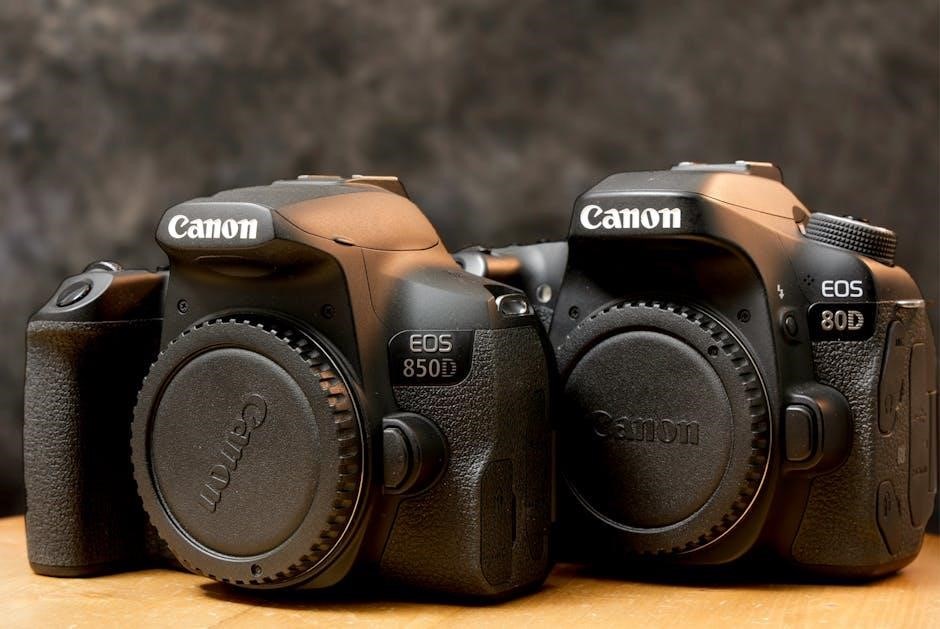
External microphone input allows for superior audio quality, and the headphone jack enables real-time audio monitoring. Clean HDMI output facilitates external recording, expanding creative possibilities for videographers.
Full HD Video Capabilities
The Canon 80D captures stunning Full HD 1080p video at selectable frame rates of 24, 30, and 60 frames per second. This versatility allows for creative control over motion and visual style. The camera supports both standard and high frame rate recording options.
Internal recording is available in MP4 format, simplifying post-production workflows. The 80D’s advanced video features deliver professional-quality results for various filmmaking applications.
Manual Video Controls
The Canon 80D provides extensive manual control over video settings, empowering filmmakers with creative freedom. Users can adjust aperture, shutter speed, and ISO sensitivity for precise exposure control. Full manual audio level adjustment is also available, ensuring optimal sound quality.
Focus peaking and zebra stripes assist in achieving sharp focus and proper exposure. These features are crucial for professional-looking video production, offering a refined cinematic experience.
Understanding the DIGIC 6 Image Processor
The Canon 80D’s DIGIC 6 image processor is central to its performance, delivering exceptional image quality and speed. It efficiently handles data from the 24.2MP sensor, enabling fast continuous shooting and responsive operation. This processor significantly reduces noise at higher ISO settings, enhancing low-light performance.
DIGIC 6 also contributes to accurate color reproduction and detailed image processing, resulting in vibrant and lifelike photographs and videos.
Image Processing and Speed
The DIGIC 6 processor dramatically boosts the Canon 80D’s image processing capabilities and overall speed. It allows for rapid handling of large image files, facilitating quick image review and editing. Continuous shooting reaches up to 7 frames per second, ideal for capturing action.
Furthermore, the processor’s efficiency minimizes processing lag, ensuring a smooth and responsive user experience during both still photography and video recording.
Customizing the Canon 80D
The Canon 80D offers extensive customization options to tailor the camera to your shooting style. Custom Function settings allow you to assign specific operations to buttons and dials, streamlining your workflow.
The ‘My Menu’ feature enables you to create a personalized menu with frequently used settings for quick access. This level of personalization ensures the camera adapts to you, not the other way around, maximizing efficiency and control.
Custom Function Settings
Canon 80D’s Custom Function settings provide granular control over camera behavior. These settings allow reassignment of buttons and dials, optimizing operation for individual preferences. You can customize autofocus initiation, exposure settings, and more.
Explore options like assigning AF-ON button functionality or altering the behavior of the Quick Control screen. Experimenting with these functions unlocks a personalized shooting experience, enhancing speed and responsiveness for various photographic scenarios.
My Menu – Personalizing Your Camera
The “My Menu” feature on the Canon 80D allows for ultimate personalization. Register frequently used settings for quick access, streamlining your workflow. This eliminates navigating through complex menu structures, saving valuable time during shoots.
Create up to three custom menus, organizing settings based on shooting style or genre. Prioritize functions like image quality, autofocus, or metering, ensuring essential controls are always at your fingertips. This boosts efficiency and creative control.
Checking Shutter Count
Determining the Canon 80D’s shutter count is crucial when buying or selling used cameras. While Canon doesn’t offer a built-in function, software solutions exist. Programs like 40DShutterCount, developed based on the Canon SDK, can retrieve this information.
These tools access the camera’s internal data via USB connection, displaying the total number of shutter actuations. Knowing the shutter count helps assess the camera’s lifespan and potential wear, informing its value and reliability.
Methods for Determining Shutter Actuations (Software Solutions)

Several software options can reveal the Canon 80D’s shutter count. AstroJargon.net’s 40DShutterCount, built upon the Canon SDK, is a popular choice. These programs connect to your camera via USB, extracting the shutter actuation data directly from the camera’s firmware.
Ensure the software is from a reputable source to avoid malware. These tools provide a quick and non-invasive way to assess the camera’s usage history, aiding in informed purchasing decisions.
Troubleshooting Common Issues
The Canon 80D may occasionally display error codes, such as “Err 99”. This often indicates a CMOS sensor issue, potentially triggered by water damage – as seen in reported cases with the 40D. Symptoms include a white bar on images in Live View mode.
Avoid attempting repairs yourself; professional servicing is recommended. Careful handling and protection from moisture are crucial preventative measures to minimize these potential problems.
Error Codes and Solutions (e.g., Err 99)
The “Err 99” code on the Canon 80D frequently signals a problem with the CMOS sensor. Reports indicate this can occur after water exposure, as experienced with the 40D model. A visible white bar appearing on the lower portion of images in Live View is a common symptom.
Attempting manual cleaning isn’t advised; seek professional repair. This error often necessitates specialized servicing to resolve the underlying sensor issue effectively.
Dealing with Water Damage
Water damage to a Canon 80D is a serious issue requiring immediate attention. As seen with a water-damaged 40D, even limited exposure can lead to errors like “Err 99” after approximately 7000 shutter actuations. Do not attempt to power on the camera if wet.
Remove the battery and memory card immediately. Professional cleaning and repair are crucial to prevent corrosion and further internal damage. DIY attempts can worsen the situation.
Lens Serial Number Decoding
Canon EF lens serial numbers reveal production dates, aiding in determining lens age and potential manufacturing revisions. Previously, a two-letter, four-digit code indicated the year and month of production. However, since mid-2011, Canon transitioned to a ten-digit numerical sequence.
Resources like TheDigitalPicture have decoded these patterns, allowing owners to estimate when their lenses were manufactured. This information can be useful for warranty claims or assessing lens condition.
Understanding Lens Production Dates
Decoding a Canon EF lens’s serial number reveals its manufacturing date, offering insights into potential design iterations and quality control periods. Before 2011, the serial number featured a two-character code followed by four digits, directly indicating the year and month.
Post-2011 lenses employ a ten-digit numerical sequence. Websites like TheDigitalPicture provide tools to decipher these newer serial numbers, helping owners pinpoint the lens’s production timeframe.
Canon EF Lens Optical Structure & MTF
Evaluating a Canon EF lens requires understanding its optical structure and Modulation Transfer Function (MTF) charts. The optical structure—the arrangement of lens elements—fundamentally impacts image quality and characteristics like distortion and aberrations.
MTF charts objectively assess a lens’s ability to resolve fine details across the image frame. Analyzing these charts helps photographers determine sharpness, contrast, and overall image quality performance.
Evaluating Lens Image Quality
Assessing lens image quality involves considering sharpness, contrast, distortion, and chromatic aberration. Sharpness dictates detail resolution, while contrast impacts image depth and clarity. Distortion affects straight lines, and chromatic aberration manifests as color fringing.
Utilizing MTF charts and real-world test images provides a comprehensive evaluation. Examining corner sharpness and vignetting is crucial, alongside assessing the lens’s performance at various apertures. Careful analysis ensures optimal results.
Basic Camera Settings for Beginners
New Canon 80D users should start with the ‘P’ (Program) mode for balanced control. Set the image quality to JPEG for ease of use, and the ISO to Auto, limiting the maximum ISO to 3200 to minimize noise.
Enable auto white balance for accurate colors, and utilize evaluative metering for general scenes. Familiarize yourself with the autofocus point selection and choose a single point for static subjects. These settings provide a solid foundation.
Recommended Settings for New Users
For beginners, prioritize Program (P) mode for a blend of automation and control. Select a JPEG image quality to simplify post-processing, and set ISO to Auto, capping it at 3200 to manage noise effectively.
Employ evaluative metering for versatile exposure, and utilize auto white balance for accurate color rendition. Begin with single-point autofocus for stationary subjects, mastering focus before exploring advanced options. These settings offer a user-friendly starting point.
Canon A-1 Legacy & Historical Context
The Canon 80D builds upon a rich heritage, tracing back to the groundbreaking Canon A-1, released in 1976. The A-1 pioneered microprocessor control in SLR cameras, revolutionizing photography with its automated features and user convenience.
This legacy of innovation continues with the 80D’s advanced autofocus, metering, and image processing capabilities. Canon’s commitment to technological advancement, started with the A-1, defines the 80D’s sophisticated performance.
Evolution of Canon Camera Technology
Canon’s journey from the A-1 to the 80D showcases remarkable technological leaps. Early innovations like shutter priority auto-exposure paved the way for the 80D’s diverse shooting modes. The introduction of USM and STM focusing motors, building on earlier designs, culminated in the 80D’s Nano USM.
Digital image processing, originating with the DIGIC series, now reaches a sophisticated level in the 80D, enhancing image quality and speed. Each generation reflects Canon’s dedication to photographic excellence.
Nano USM Focusing Technology
The Canon 80D features Nano USM, a revolutionary focusing technology. Unlike traditional USM or STM, Nano USM combines the benefits of both – high speed and silent operation. This allows for incredibly smooth and quiet autofocus during both still photography and video recording.
It delivers precise control, enhancing performance with compatible lenses like the EF-S 18-135mm. Nano USM represents a significant advancement in Canon’s autofocus capabilities.
Benefits of Nano USM in the 80D
Nano USM within the 80D provides substantial advantages for photographers and videographers. Its silent operation is crucial for discreet shooting during events or wildlife photography, avoiding disturbance. The high-speed autofocus ensures sharp images, even with moving subjects, enhancing action shots.
Furthermore, Nano USM offers exceptionally smooth and precise focusing transitions, ideal for professional-quality video content creation. It elevates the 80D’s overall performance.